Gold tracker card · fits a wallet slot
Ondrela: the card that tells you where your wallet went
Ondrela is a tracker cut to the shape of a bank card, so it hides in the slot you were not using and reports back to the app already on your phone. No download, no account, no monthly bill, and roughly six months between charges. Prices start at $24.99 a card.
One payment · no subscription · wireless charging · 60-day returns
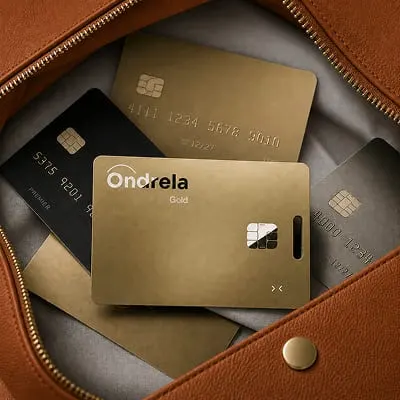
The problem Ondrela is built for
Almost nobody buys a tracker because they are fascinated by radios. They buy one after a bad afternoon.
The wallet is the worst thing to lose and the easiest to misplace. It is flat, it is quiet, it slides between sofa cushions and under car seats, and it carries the three or four items that are most tedious to replace. A set of keys at least makes a noise when it hits the floor. A wallet makes none, which is exactly why it is still missing an hour later.
Every tracker before this one solved the problem for keys and bags, because those have somewhere to hang a fob. A wallet does not. You either carry a lump that stops the thing closing, or you carry nothing and hope. Ondrela's entire argument is the shape: put the tracker in the form of a card, and the wallet becomes the one place it fits perfectly.
A card slot you were not using is the whole installation.
See Ondrela pricesHow Ondrela answers it
Three jobs, each useful at a different distance from the thing you lost.
Within earshot
Tell your phone to ring the card and follow the sound. This is the one that finds a wallet down the side of an armchair, and it is the feature people end up using most.
Within the room you just left
Walk away from the card and your phone can flag it before you get far. Useful at a cafe table, a hotel desk, or a security tray.
Anywhere else
Open the map and see the last place the card was seen. This is where the finding network does the work, and where coverage decides how fresh that position is.
The third one deserves a sentence of explanation, because it is the one people misunderstand. A card this thin has no satellite receiver and no data connection of its own. What it has is a short-range radio that other compatible phones can overhear as they pass. Those phones pass the position along quietly, which is why a card left in a busy airport updates quickly and a card in an empty barn does not.
Inside the Ondrela card
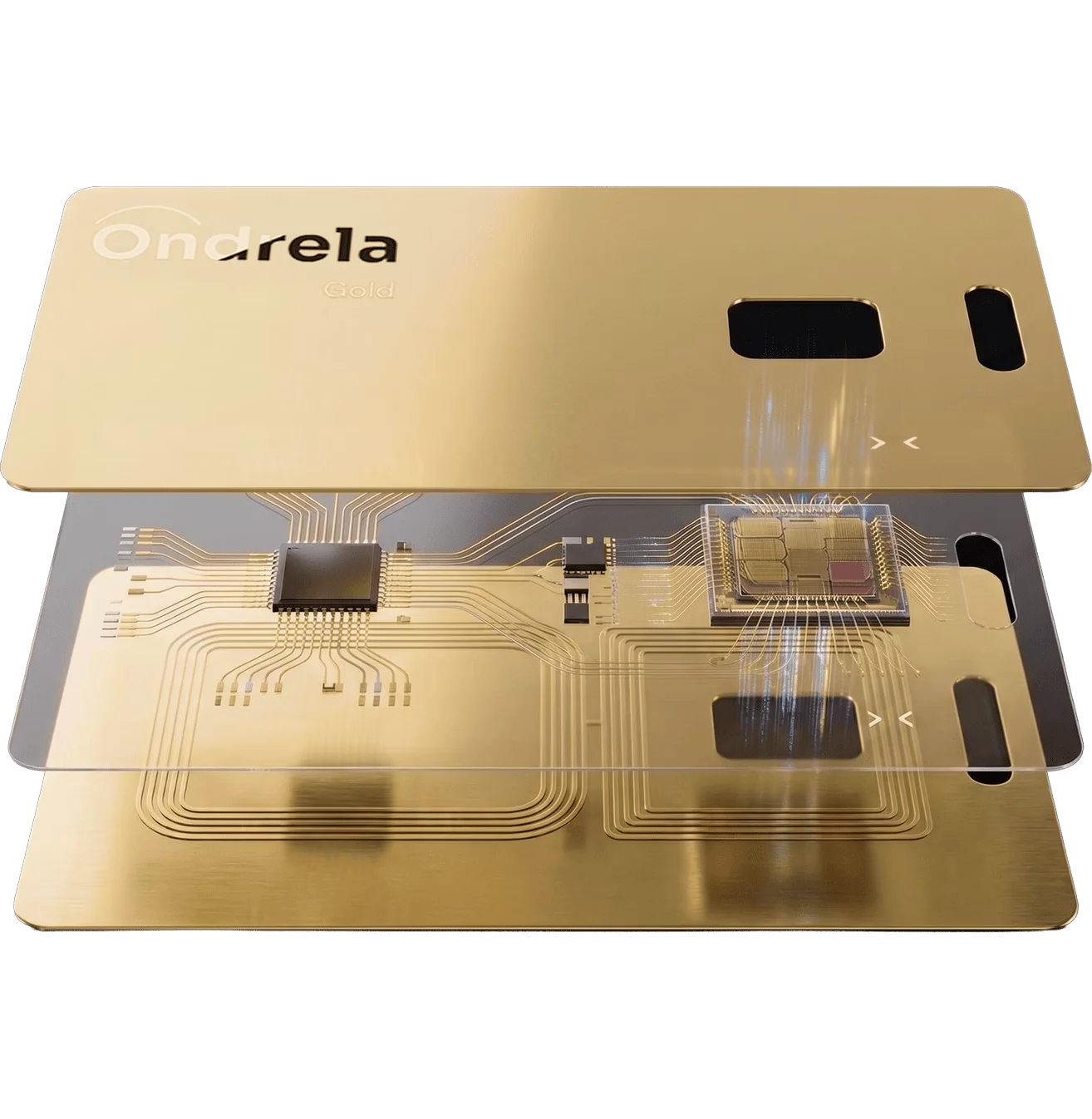
The seller's own cutaway image shows the card in three pieces. Each one is solving a different problem.
The gold face
The surface you see between your bank cards, carrying the wordmark. It is described as water resistant and built for daily use, which is the quality that matters for something spending its life against coins and keys.
The circuit layer
A flexible board holding the radio, the controller, the charging coil and the speaker that rings. Everything the card actually does happens on this one sheet, and squeezing it into card thickness is the hard part of the engineering.
The backing plate
The rear face that gives the card enough rigidity to survive being sat on in a back pocket, several times a day, for years. Without it the board would flex until something cracked.
Those three layers are what the manufacturer's own exploded view shows, and the finished card is sold as a single sealed object rather than something to open.
Ondrela and the phone in your pocket
Both major platforms already ship a finding feature. Ondrela registers inside the one you have.
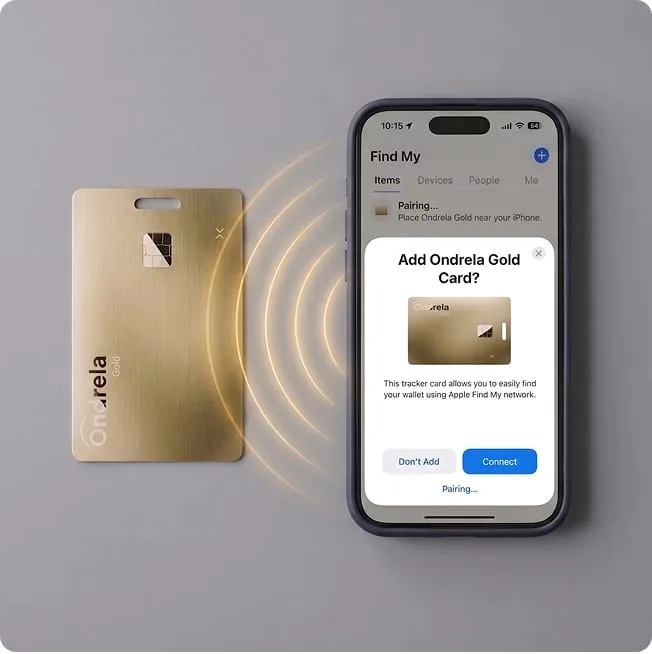
On an iPhone that app is Find My, and the card lands in your item list alongside anything else you have registered. Apple's own personal safety guidance lists unwanted tracking notifications for accessories on its network as available from iOS 14.5 or later, which covers essentially every iPhone still in use.
On an Android phone it is the Find Hub screen. Google states that its unknown tracker alerts are available for devices running Android 6 and up, and that they work with Find Hub network compatible tags and headphones as well as Apple AirTags.
Worth a thirty-second call before you order
Apple and Google operate these networks separately, and a tracker is built to join one or the other. Mention which handset you carry when you place the order so the card that arrives is the one that pairs with your phone. The seller publishes a United States telephone number, which makes this the easiest question on the whole page to settle.
Nothing to download, nothing to sign up for.
Order OndrelaYour first minute with Ondrela
The official FAQ puts setup at under a minute. Here is what that minute contains.
Open the app you already have
Find My on an iPhone, Find Hub on Android. There is nothing to install, which is the single biggest difference between this and most trackers.
Choose to add an item
Then hold the card against the back of the handset. The two introduce themselves without you typing anything.
Name it and put it away
Call it Wallet, or Passport, or whatever it is going to live in. From that moment it shows up in your item list like anything else.
One tip worth following: do this before you need it. Open the tracker app once while the parcel is still in transit and make sure you are signed in. If that part is already done, the card genuinely is a one-minute job on the day it lands.
Setup is described as taking under a minute.
Order OndrelaOndrela in numbers
Six figures that describe the product better than any paragraph.
months per charge
Long enough that charging becomes a twice-a-year habit rather than a chore.
card slot used
Roughly the footprint of a payment card, so the wallet closes as it always did.
apps to install
It joins the tracker software your handset already runs.
monthly
One payment for the hardware. No subscription and nothing to cancel later.
day returns
Two months to decide whether it has earned the slot it occupies.
lowest per card
Reached on the four-card quantity. One card on its own is $44.99.
Charging Ondrela twice a year
The best thing about this card is the thing you will think about least.
Six months from one charge, topped up on any standard wireless pad — the same one your phone or your earbuds already sit on. That is the published claim, and it is the feature that quietly separates this card from most of its shelf-mates. A great many trackers in this shape are sealed around a battery that cannot be replaced, so when it finally gives up the whole card is refuse. A rechargeable one just goes back on the pad.
Think of it as two diary entries a year rather than a maintenance task. Pick two dates you will remember — the start of spring and the start of autumn works — and leave the card on the pad while you make coffee. Real battery life in this category does shift with how often the card gets pinged and how cold a winter coat pocket gets, so a card living outdoors will want the pad a little sooner.
Two charges a year, on a pad you already own.
Order OndrelaGet your Ondrela card
A single card is $44.99. Four cards are $24.99 each, which is $99.96 in total and 70% off the $82.99 reference price. Every quantity is one payment, with the same 60-day return policy and nothing recurring behind it.
Nine places to keep an Ondrela card
The card shape opens up a few slots a keyring fob could never reach.
- Your walletThe slot it was designed around, and the reason most people buy one.
- A passport holderSlides in beside the document for the length of a trip.
- Checked luggageFlat enough for an inside pocket or the lining of a case.
- A laptop sleeveSits against the machine without adding any bulk at all.
- A camera bagGoes under the foam divider where nothing else fits.
- A bicycle saddle packThin enough for the smallest under-seat bag.
- A gloveboxLies flat under the documents most cars keep in there.
- A card-sized key walletHow to use one with keys, since the card has no keyring hole.
- A child's school bagIn the inner pocket, with the usual conversation about why it is there.
Is Ondrela right for you?
A card tracker suits some people perfectly and others barely at all. It is worth knowing which you are before you spend anything.
A good fit if
- The thing you lose most often is your wallet, your passport or a bag
- You want nothing hanging off your keys
- You travel enough that luggage anxiety is a regular feeling
- You would rather charge something twice a year than hunt for coin cells
- You want no app, no account and no monthly bill
- You have three or four things worth tagging, which makes the bundle pricing work
Less of a fit if
- Your keys are the problem, where a keyring fob is simply better suited
- You need a loud alarm, since a thin body leaves little room for a speaker
- You spend most of your time somewhere very remote, with few phones passing by
- You are looking for a security device rather than a way to find things
- You want a published figure for every specification before buying
- You expect live, second-by-second tracking of the kind a vehicle unit provides
Ondrela and unwanted tracking
The thinness that lets a card disappear into a wallet would also let it disappear into a bag that is not yours. That problem has an answer, and the answer does not come from the tracker brand.
On the owner's side of things, Ondrela describes its location data as encrypted and visible only to the person who set the card up. The opposite side — a card riding along with somebody who never agreed to carry it — is answered by the two phone platforms, which means the answer is identical whichever brand of card ends up in that bag.
2023: one standard, both platforms
Apple and Google put a joint industry specification forward that year. Apple's announcement says it will allow Bluetooth location-tracking devices to be compatible with unauthorized tracking detection and alerts across iOS and Android alike, and it does not dress up why the work was needed: trackers "can also be misused for unwanted tracking of individuals". Samsung, Tile, Chipolo, eufy Security and Pebblebee are listed in the same announcement as backing the draft.
What the warning on your own phone offers
Open the notification and either platform gives you the same three moves: make the device ring so you can find it, read off its details, and then stop. Both companies draw the line in the same place. Apple's personal safety guide says to go to a safe public location and contact law enforcement; Google's Android help page says to go to a public location and contact law enforcement or a trusted contact. Neither suggests handling it yourself.
Where the standard stops
Worth being glad of, not worth leaning on. Google's documentation puts a ceiling of one alert per tracker per day and describes several factors weighed before an alert fires at all, so a card can travel with a person for some time before a phone says anything. On the Apple side, detection of third-party trackers under the joint specification assumes a reasonably current iOS release. The protection is real and getting better; it is not a guarantee.
The one rule for owning an Ondrela
Tag the things you own. Not people, and not anything belonging to somebody else.
That is a legal line rather than a point of etiquette. Federal guidance from the Office on Violence Against Women describes stalking as engaging in a course of conduct directed at a specific person that would make a reasonable person fear for their safety or endure substantial emotional distress — a description that covers the quiet logging of where another adult spends their day. States layer their own offences on top of it, and good intentions soften none of it. If that is the use you had in mind, the answer is no.
If you believe someone is tracking you
Three steps, in this order. Ring 911 first if you are in immediate danger, which is the instruction the Office on Violence Against Women gives. Next, reach a domestic violence advocate before you pull out or switch off whatever you have found: the Federal Trade Commission's guidance on monitoring technology warns that removing a device can escalate the situation, and that the call is safer made from a handset other than your own. The National Domestic Violence Hotline answers on 1-800-799-7233, with live chat at thehotline.org.
Two further lines appear in the same federal guidance: the National Center for Victims of Crime on 855-484-2846, and the StrongHearts Native Helpline on 844-762-8483.
Nothing in this section argues against buying a tracker for your own luggage, which is what nearly every one of them ends up doing. It sits on the page because a page selling one ought to say it plainly.
What Ondrela will and will not do
Five things that hold true of every card tracker, so that what arrives matches what you pictured.
- It finds, it does not guide you in. A card this thin holds no satellite receiver; the position comes from handsets that happen to be close by. Dense places — a terminal, an office floor, a high street — are where that works best, and an empty hillside is where it falls quiet.
- It reports in bursts, not in a stream. Sealed in a cargo hold or shut inside a metal box, the card simply waits for company. What you read afterwards is where it was, not where it is this second.
- Knowing where it is does not mean going to get it. Apple and Google give identical advice when an item surfaces somewhere it should not be: do not go and fetch it yourself, contact law enforcement.
- It makes a loss recoverable, not impossible. The card reports where the wallet went. It does not lock the wallet, and whoever picks it up can lift the card straight out of the slot.
- It is a finder, not a leash. The two sections above cover why in full, and of everything on this list it is the one point that is not negotiable.
Not one of those five is a claim the seller has made. They are written out because the category invites the assumptions, and a first tracker ought to arrive without any.
Ondrela pricing, quantity by quantity
Four quantities, one payment each, and a per-card price that drops sharply as the count rises.
| 1 card | 2 cards | 3 cards | 4 cards Best | |
|---|---|---|---|---|
| Price per card | $44.99 | $34.99 | $29.99 | $24.99 |
| You pay | $44.99 | $69.98 | $89.97 | $99.96 |
| Reference price | $82.99 | $165.98 | $248.97 | $331.96 |
| You save | $38.00 | $96.00 | $159.00 | $232.00 |
| Discount | 46% off | 58% off | 64% off | 70% off |
| Return window | 60 days | 60 days | 60 days | 60 days |
| Recurring charges | None | None | None | None |
| Order | Buy 1 | Buy 2 | Buy 3 | Buy 4 |
Every reference figure in that row is the same $82.99 single-card price multiplied out, which is where all four percentages come from. Postage is calculated at the checkout, and the seller's order page notes that taxes may apply on top.
The four-card quantity is where the per-card price bottoms out.
Order OndrelaChoosing an Ondrela quantity
The jump from one card to two is the steepest discount on the page. After that it flattens out.
Buy one and you pay $44.99. Buy two and the pair costs $69.98, which means the second card effectively costs $25 rather than another $44.99. That is the single best move in the range, and it is worth knowing even if you only have one thing you genuinely worry about: a spare in a suitcase costs very little once the first is paid for.
From there the curve softens. Three cards work out at $29.99 each and four at $24.99, so going from three to four adds $9.99 for a whole extra card. If you can name a fourth item that would annoy you to lose, the four-card quantity is close to free money; if you cannot, buying it to chase the 70% headline is just spending $9.99 on a card that will sit in a drawer needing charged twice a year.
A quick way to decide
Write down the things you have actually lost or panicked about in the last two years. Not the things you could imagine losing — the real ones. Most people land on two or three: a wallet, a passport during a trip, a laptop bag left under a desk. Buy that many, and let the discount be a consequence of the list rather than the reason for it.
Two cards cost $69.98, so the second works out at $25.
Order OndrelaPick your Ondrela quantity
One card at $44.99 for the thing you lose most. Two at $69.98, where the second card effectively costs $25. Three at $89.97. Four at $99.96, which is $24.99 a card and the deepest discount on offer. Every quantity ships with the same 60-day return window.
After you order Ondrela
What happens between the payment going through and the card reaching your wallet.
- Your order is tracked. The official site maintains a Track My Order page, so a reference is issued once a parcel is moving.
- Postage is worked out at the checkout. It is calculated there along with the quantity, and the order page notes that taxes may apply.
- A shipping policy is published. Delivery arrangements live on their own page, linked from the official site's footer.
- You are charged once. The card is bought outright. There is no plan running behind it and nothing to cancel later on.
- Open your tracker app while you wait. The one piece of homework worth doing in advance, so pairing really is a one-minute job.
One payment, tracked delivery, nothing recurring.
Order OndrelaSending an Ondrela card back
Sixty days on every quantity, which is a long window for a purchase of this size.
Two months is long enough to settle the three things a product page cannot settle for you. Whether the card suits the wallet you actually own rather than the one in the photograph. Whether it pairs without a fight with the handset in your pocket. And whether the walk-away alert speaks up when you want it to instead of every time you step into the garden. That is the work the window is there to do.
Conditions in full sit on the Returns and Refunds Policy page linked from the official site, and it reads better before an order than after one. Keep the order confirmation as well: it carries the reference a return is processed against, and a call to the published telephone number is the quickest way to set one going.
Two months to decide whether it earns its slot.
Order OndrelaReaching the Ondrela team
An ordinary detail that turns out to matter more than half the specification.
The official site publishes a telephone number in the United States, +1 970-236-2765. Dial it and you are calling a 970 number, the code covering the northern and western side of Colorado. That matters more than it reads. Plenty of products sold through one page offer a web form and then silence, and a line somebody answers is the difference between a problem that gets closed and a thread that never does.
Anything in writing goes through the contact form on the same site, and Terms of Service, Privacy Policy, Returns and Refunds, and Shipping each have a page of their own. A phone line, a form and four policy pages between them leave a route to a person for whatever the product page does not answer.
A habit worth adopting for any hardware bought online: ring before you order, ask where returns are sent and how long the card is covered for, and write the answers on the order confirmation. If you ever need them, you will have them in one place.
Why Ondrela is a card and not a fob
The shape is the entire product decision, and it is worth understanding what it buys and what it costs.
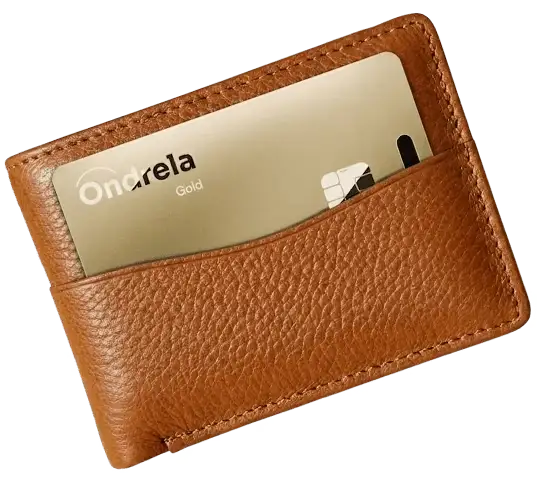
A keyring fob has an easier job. It can be thick, which leaves room for a bigger battery and a louder speaker, and it usually takes a coin cell you can swap in thirty seconds. What it cannot do is go in a wallet without turning it into a brick, which rules it out of the one place most people actually need a tracker.
The card shape inverts all of that. It fits where nothing else fits and disappears entirely in use, but every millimetre has to be fought for, which is why rechargeable designs like this one exist at all — there is simply no room for a swappable cell. The trade is a quieter ring and a larger surface that is easier to spot, in exchange for being somewhere a fob could never go.
Neither shape is better in the abstract. If the item you lose is your keys, buy a fob. If it is your wallet, a card is the only answer that works. The comparison above is about the two form factors generally and is not a claim about any named competing product.
Ondrela questions and answers
Ten questions, each answered straight from the official listing.
So what is an Ondrela card?
Gold, card-shaped, and sized for the slot a bank card lives in — which also covers a passport holder, a suitcase lining, a laptop sleeve or the pocket of a bike bag. It reports to the tracker feature your phone already has, and from there you get a pin on a map, a ring-it button for when the thing is somewhere in the room, and a nudge if you walk off without it.
Do I have to install anything?
Nothing, and that is rather the point. The official FAQ puts it plainly: no separate app, and the card joins the phone's built-in tracker feature in under a minute. The whole procedure is opening that app, telling it to add an item, and holding the card against the handset.
Is there a subscription behind it?
There is not. The seller states there are no monthly fees or subscriptions, and the order page calls it a one-time purchase. The hardware is what you pay for; the finding network doing the legwork is the one your phone's maker already operates.
How often will I be charging it?
Roughly twice a year. The published figure is about six months from a charge, and topping it up means laying the card on any standard wireless pad — the one on your desk for a phone or earbuds will do. Nothing to unscrew, and no coin cell to hunt down.
Will it actually fit my wallet?
The benchmark the official FAQ gives is about as thin as a standard credit card, and that is a claim you can test in ten seconds against whatever is in your wallet now. It takes one slot, and it is built so the wallet still shuts the way it did before.
iPhone or Android — does it matter?
Either one works: the seller states the card runs with the tracker app built into iPhone or Android, with nothing extra installed on either. The two finding networks are run separately by Apple and by Google, though, so mention which handset you carry when you order. Apple's unwanted tracking notifications are listed from iOS 14.5 onward, and Google's unknown tracker alerts cover Android 6 and up.
What happens if it gets wet?
Rain, a knocked-over glass, an afternoon in a damp coat: all of that sits inside what water resistant and built for daily use is meant to cover. Water resistant and waterproof are different claims and only the first is being made, so a swim or a wash cycle falls outside what it is sold for.
What will it cost me?
Four quantities on one ladder. A single card runs $44.99, down 46% from the $82.99 reference figure. A pair is $34.99 a card and $69.98 together, down 58%. At three it is $29.99 a card for $89.97 in total, down 64%. At four it is $24.99 a card for $99.96 in total, the full 70%. Postage is calculated at the checkout and the order page notes that taxes may apply.
And if it turns out not to suit me?
A 60-day return policy applies to every quantity, and the conditions in full sit on the Returns and Refunds Policy page linked from the official site. A United States telephone number is published too, +1 970-236-2765, and a call is the quickest way to get a return moving.
Could somebody use one of these to follow a person?
Any tracker this size can be misused, which is precisely why Apple and Google built unwanted-tracking alerts into iOS and Android together. Apple lists notifications for accessories on its network from iOS 14.5, and Google's unknown tracker alerts cover Android 6 and up. Following an adult's movements without their knowledge can amount to stalking under the federal definition, and the Office on Violence Against Women says to ring 911 if you are in immediate danger.
Ondrela jargon, translated
Eight phrases you will meet on the listing or inside your phone's settings.
- Finding network
- Other people's phones, doing the work. A handset walking past overhears a card and forwards the position to its owner; the card itself never sends anything anywhere. Each platform operates a network of its own, and a given tracker belongs to one of them.
- Walk-away alert
- Your phone, not the card, noticing that the pair of them have separated. It fires on the signal dropping as you leave, which is also why it can fire when you leave the card behind deliberately.
- Unknown tracker alert
- The same idea pointed the other way: a warning that a tracker nobody told you about is keeping pace with you. Shipped as standard on iOS and on Android.
- Water resistant
- Rain, spills and a damp coat pocket. Not a bath and not a swimming pool, because resistant and proof are two different words and only the first one is on the listing.
- Wireless charging pad
- The flat inductive pad already charging your phone or your earbuds. The card takes a charge from any standard one, so nothing proprietary needs keeping in a drawer.
- Reference price
- The "before" figure a discount is measured down from. Here it is one card at $82.99, multiplied by the quantity — which is how a single ladder produces four different percentages.
- One-time purchase
- One charge, and nothing afterwards. The order page uses the phrase to separate this card from trackers that bill you every month.
- Last-known position
- The spot where a phone last overheard the card. What a finding network hands you is that pin on a map, rather than a dot moving in real time.
How this Ondrela page was researched
Where the facts came from, and the commercial arrangement behind the links.
Everything describing the product comes from the official Ondrela listing and its order page as they read on 18 November 2026: the card shape and finish, the six-month battery, the wireless charging, the water-resistance wording, the credit-card thickness comparison, the no-app setup, the published telephone number, the one-time-purchase and taxes notes, the 60-day return policy and all four quantity prices. No figure has been estimated, and each discount percentage was recalculated from the seller's own $82.99 reference price rather than copied across.
None of it is a review. There is no score on this page, no star rating and no testimonial, and product photography was supplied by the seller. Anything reaching past the listing — how finding networks behave, what unwanted-tracking alerts do, where the law sits — is anchored to Apple, Google, the Federal Trade Commission and the Department of Justice, and linked so you can check it instead of taking our word.
If you buy through a link here, the seller pays us a commission out of its own margin and your total is identical either way. Not one line above was bought by that arrangement. The sections on how a finding network really behaves, and on the unwanted-tracking question, are here because a page that prints only the flattering half leaves a buyer with nothing to work with.